Cart
0
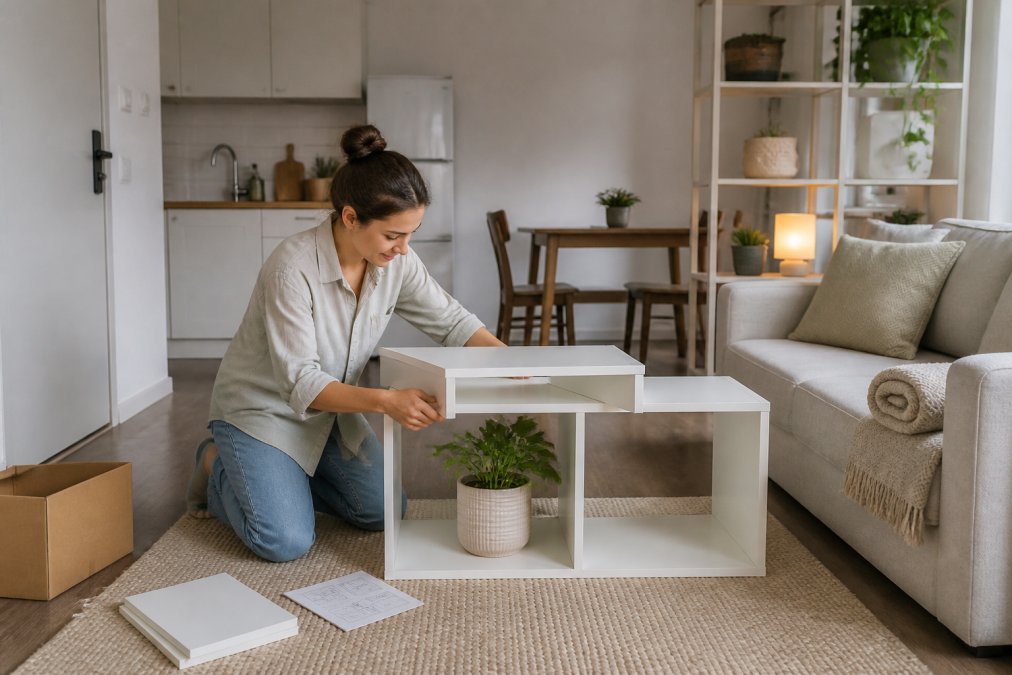
Table of Contents
- Modular Furniture Pros and Cons for First Apartments
- Flexibility and Room Layout Adaptability
- Best Modular Sofas for Small Apartments
- Cost Analysis: Upfront Price vs. Long-Term Value
- Space-Saving Furniture Ideas for Renters
- Maintenance, Durability, and Component Replacement
- Delivery, Assembly, and Moving Logistics
- The Verdict: Is Modular Furniture Worth It?
Last Updated: August 6, 2026
Modular Furniture Pros and Cons for First Apartments
Is modular furniture worth it for first apartments? The answer depends on your priorities, budget, and moving frequency. For renters and first-time homeowners, modular pieces offer genuine flexibility that fixed furniture cannot match. But that flexibility comes with trade-offs: higher upfront costs, potential durability concerns with lightweight frames, and the reality that not every configuration works in every space.
At AllWayzHome, we understand that furnishing your first apartment involves balancing aesthetics, functionality, and practicality. The real question isn't whether modular furniture is "worth it" in absolute terms, but whether the specific benefits align with your living situation, how long you plan to stay, and whether you'll actually use the reconfigurability that justifies the premium price.
Key Advantages for Renters and New Homeowners
Modular furniture solves real problems for apartment dwellers. The primary advantage is spatial flexibility, modular pieces adapt to unusual room shapes, narrow doorways, and unconventional layouts without requiring you to buy new furniture.
Delivery and moving logistics matter significantly. Standard sectionals arrive as one massive unit, making them difficult to move through doorways. Modular sofas ship in smaller, manageable boxes that fit through standard doorways. For renters who expect to move within a year or two, this is a genuine advantage. You can disassemble, pack, and transport pieces yourself without hiring expensive moving services.
Modular design also addresses the "growing with your space" narrative. Start with a two-seat configuration in a studio, then add an ottoman or chaise when you upgrade to a one-bedroom. Over five to seven years, this can feel like better value than buying multiple fixed sofas as your living situation evolves.
Real Drawbacks to Consider Before Buying
The price premium is substantial. A modular sofa typically costs 20-40% more than a comparable fixed sectional with similar materials and comfort level. You're paying for the engineering that makes reconfiguration possible: reinforced joints, standardized connector systems, and individual frame construction for each piece.
Durability becomes a real concern with lightweight modular frames. Cheaper modular options prioritize portability over structural integrity. Repeated assembly and disassembly stresses the connection points, and after three or four moves, some modular sofas develop wobbling or creaking.
Weight distribution is another issue. When you separate a modular sofa into individual pieces, each component becomes lighter and potentially less stable. Tall, narrow pieces can tip more easily than a single, unified frame.
Finally, not all configurations actually work. Your apartment might have a radiator, outlet, or architectural feature that prevents the "ideal" configuration, leaving you with a compromise layout that doesn't fully use the modularity you paid for.
Flexibility and Room Layout Adaptability
The flexibility promise of modular furniture is real but conditional. A modular sofa lets you configure an L-shape, U-shape, or straight line depending on your space. This adaptability is genuinely valuable in small apartments where every square foot matters.
However, flexibility has limits. Most modular systems offer 4-8 realistic configurations, not infinite possibilities. The connectors are standardized, which means you can't arbitrarily combine pieces from different brands. Marketing photos show picture-perfect living rooms, but your actual apartment likely has constraints, windows, doors, heating vents, or irregular wall shapes, that eliminate half the theoretical configurations.
For renters, this adaptability becomes more valuable over time. Moving between apartments with different layouts is where modular furniture earns its premium. In a fixed apartment where you plan to stay five years or more, the flexibility advantage diminishes significantly.
The real value is in spatial optimization. Small apartments benefit most from modular pieces because they allow you to use corner space, fit around architectural quirks, and adjust the footprint without replacing the entire piece.
Best Modular Sofas for Small Apartments
High-Comfort Options: Albany Park and Inside Weather
The Albany Park Kova Sectional prioritizes comfort with deep 25-inch seat depths and ultra-fluffy cushions, making it excellent for lounging and extended relaxation. The modular design means you can start with a two-seat configuration and expand later. Hypoallergenic microfiber fill appeals to renters concerned about allergens. The tradeoff: the depth might overwhelm layouts in studio apartments under 400 square feet.
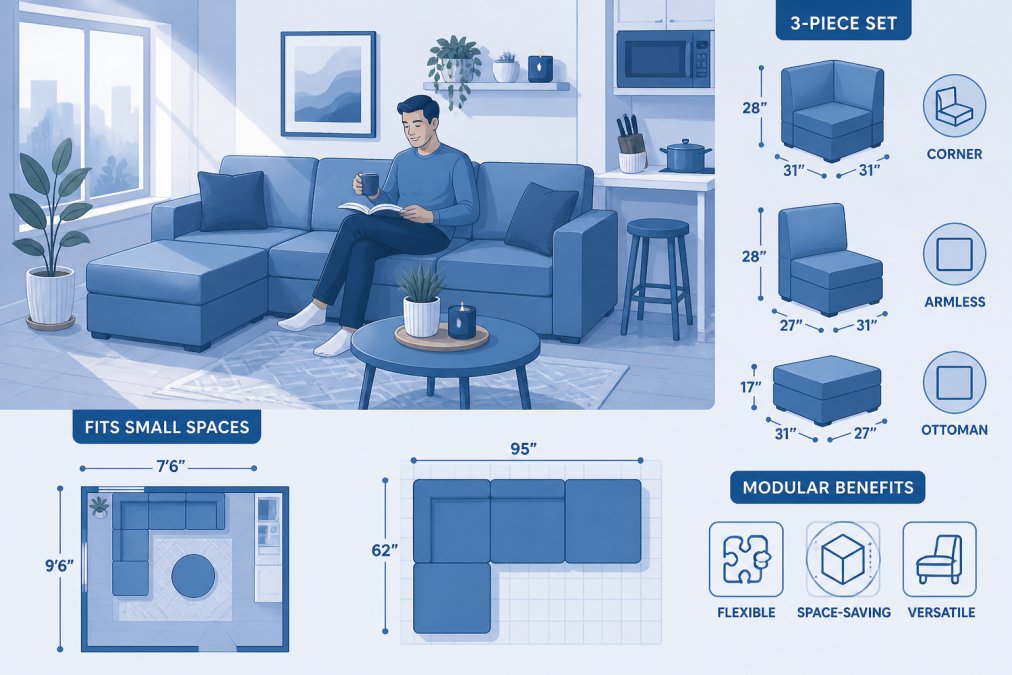
Inside Weather's Bondi Sofa combines deep seats with washable covers and sustainable materials. The 25-inch seat depth matches the Kova, but the design is cleaner and more minimalist, which matters in small apartments where visual clutter affects perception of space. Washable covers are a genuine advantage for renters, spills don't mean permanent stains or expensive cleaning. The drawback: deeper seats mean shorter people may struggle to rest their feet on the floor comfortably.
Both options cost significantly more than budget alternatives, but they deliver on comfort and durability for renters planning to keep the sofa through multiple moves.
Budget-Friendly and Minimalist Choices
Burrow's modular sofas (Nomad, Range, Field, Union) target renters explicitly. They ship in manageable boxes, assemble without tools, and reconfigure easily. Starting prices around $1,095 for smaller pieces make Burrow accessible for first-apartment budgets. The designs are intentionally minimalist, which works well in small spaces where visual simplicity prevents the apartment from feeling cramped.
The tradeoff: some Burrow models have shallow seat depths (around 20 inches), which feels less lounging-friendly than deeper alternatives. The stain-resistant fabrics are practical for renters, and the modular design genuinely supports frequent moving.
IKEA's modular sofas (FINNALA and similar) offer maximum affordability and flexibility. Individual sections start as low as $200-$300, allowing you to build a configuration piece by piece as your budget allows. Removable, washable covers are standard.
The reality: IKEA modular pieces prioritize price over durability. After three to five years of regular use, some users report sagging cushions or loose connections. For a first apartment where you might stay only one or two years, this is acceptable.
| Brand | Starting Price | Seat Depth | Best For | Key Tradeoff |
|---|---|---|---|---|
| Albany Park Kova | Varies by config | 25 inches | Maximum comfort, lounging | Takes up more floor space |
| Inside Weather Bondi | Varies by config | 25 inches | Eco-conscious, washable covers | Deep seats not ideal for short people |
| Burrow (Nomad, Range) | $1,095+ | 20 inches | Renters, minimalist design | Shallower seats, less lounging comfort |
| IKEA Modular | $200-$300 per section | 18-22 inches | Budget-conscious, customization | Lower durability, sagging over time |
Cost Analysis: Upfront Price vs. Long-Term Value
The upfront cost of modular furniture is 20-40% higher than equivalent fixed sofas. For a first apartment budget already stretched thin, this premium stings.
However, the long-term value calculation depends on your moving frequency. If you move every two years, the ability to disassemble and transport the sofa yourself saves money on moving labor. A professional furniture mover charges $200-$500 just to handle a sectional. Over three moves, you're already recovering the premium you paid upfront.
The modularity also extends useful life. As your living situation changes, you can reconfigure the sofa rather than replace it. A fixed sofa that doesn't fit your new space becomes a disposal problem or a second-hand sale at steep discounts.
Where modular furniture loses value: if you stay in one apartment for five years or more, the flexibility benefit disappears. You're paying a premium for adaptability you never use.
Durability also affects long-term value. A well-made modular sofa from Albany Park or Inside Weather should last 7-10 years with normal use. Budget options like IKEA might show wear after 4-5 years. Calculate the cost per year of use: a $3,000 sofa lasting 10 years costs $300 per year. A $1,500 sofa lasting 5 years also costs $300 per year, but the premium option offers more flexibility during that decade.
Key Takeaway
Modular furniture is worth it if you plan to move 2+ times before settling, or if your first apartment has an unusual layout that fixed furniture won't accommodate. Otherwise, a cheaper fixed sectional offers better value.
Space-Saving Furniture Ideas for Renters
Modular furniture is one tool for space optimization, but it's not the only one. Modular shelving systems like MUJI's SUS Shelving or basic cube storage units maximize vertical space in small apartments. Unlike built-in shelving, they move with you to your next apartment. A 4x4 cube unit costs $100-$300 and can serve as a bookcase, room divider, TV stand, or storage depending on configuration.
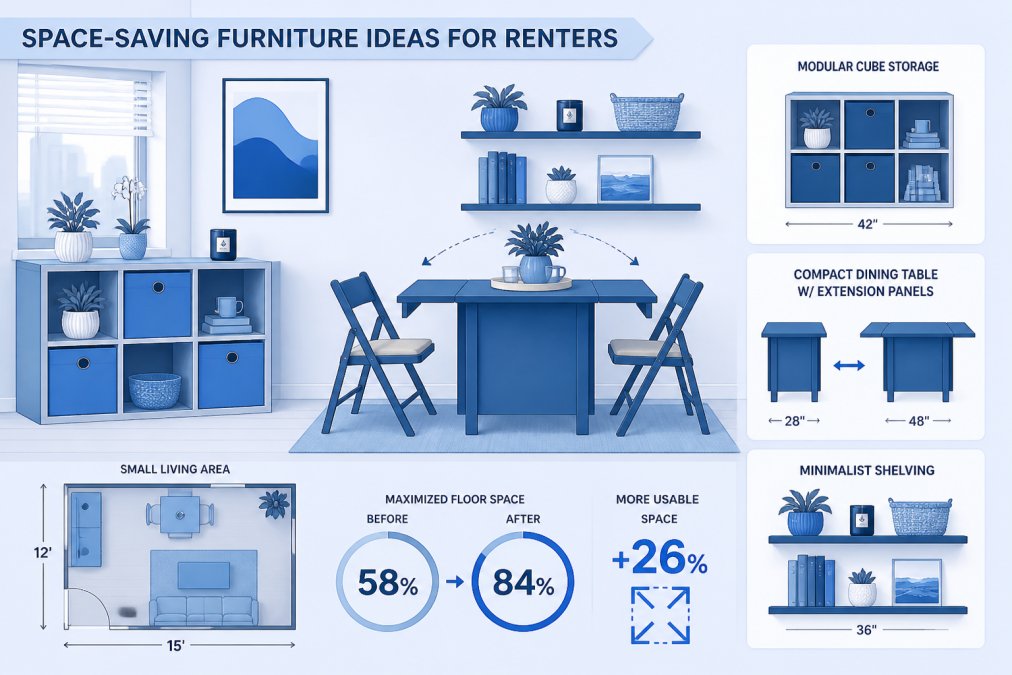
Transformer tables address the dining-workspace problem in studio apartments. These tables expand from 24 inches to 60+ inches using modular extension panels. In your first apartment, this single piece replaces both a dining table and a work desk. Extension panels store vertically, using minimal floor space.
Modular storage ottomans serve double duty: seating and hidden storage. In a studio or one-bedroom, an ottoman that opens to reveal storage for blankets or seasonal clothing keeps your apartment from feeling cluttered.
The broader principle: in small apartments, every piece should serve multiple functions.
Pro Tip
Before buying any modular piece for a small apartment, measure your doorways and stairwells. Even though modular furniture ships in smaller boxes, individual components still have dimensional limits. A piece that fits through your apartment door might not fit through the building's front entrance.
Maintenance, Durability, and Component Replacement
Maintenance is easier in some ways, harder in others. Washable covers (available on Inside Weather and some IKEA options) are a genuine advantage for renters. You can remove the cover, wash it, and reinstall it without professional cleaning services.
Durability depends entirely on construction quality. High-end modular sofas from Albany Park or Inside Weather use reinforced hardwood frames and eight-way hand-tied springs, similar to traditional sofas. These pieces withstand 7-10 years of regular use. Budget modular options like IKEA use engineered wood and sintered steel springs, which show wear faster.
Component replacement is a hidden cost. If a cushion degrades after five years, can you buy just that cushion, or do you need to replace the entire section? Most modular brands allow individual cushion replacement, but at a cost. A replacement cushion for a mid-range modular sofa runs $200-$400.
The connector systems also matter. Cheap modular sofas use plastic connectors that weaken with repeated assembly and disassembly. Better brands use reinforced metal connectors designed for dozens of reconfigurations. If you move four times and reconfigure the sofa each time, cheap connectors will eventually fail.
For renters, the real durability question is: will this piece survive your moving cycle intact?
Delivery, Assembly, and Moving Logistics
Modular furniture genuinely outperforms traditional sofas for renters. Delivery logistics are simpler. Standard sectionals arrive as one or two massive boxes requiring careful maneuvering. Modular sofas ship as 4-6 smaller boxes, each light enough for one person to handle.
Assembly is intentionally designed to be simple. Most modular sofas assemble without tools using built-in connectors or clips. Setup typically takes 30-60 minutes for one person.
Moving logistics are the real advantage. When you move to a new apartment, you disassemble the sofa, pack the pieces, and reassemble them in your new space. This saves money and gives you control over the process.
However, moving logistics have limits. Modular sofas are heavier than they look. Even individual pieces can weigh 40-80 pounds. Moving a four-piece sectional requires handling 160-320 pounds of furniture. If you're moving up three flights of stairs, this becomes physically demanding.
Also, repeated assembly and disassembly stresses the connector systems. After five or six moves, some modular sofas develop wobbling or creaking that wasn't present when new.
Watch Out
Before buying a modular sofa, check your building's elevator and stairwell dimensions. A piece that fits through apartment doors might not fit through the building's main entrance. Some renters have discovered this too late and couldn't move their sofa out of the apartment when their lease ended.
The Verdict: Is Modular Furniture Worth It?
Modular furniture is worth it if you plan to move within the next 3-5 years, your first apartment has an unusual layout or space constraints, and you're willing to pay a 20-40% premium for flexibility. For renters in this situation, modular sofas and storage solutions genuinely solve problems that fixed furniture cannot address.
If you're moving into a standard rectangular apartment that will accommodate any sofa, and you plan to stay for five years or more, traditional fixed furniture offers better value.
For AllWayzHome customers furnishing a first apartment, the real question isn't just about the sofa. It's about how you approach your entire living space. Modular furniture pairs well with curated, flexible décor that adapts as your taste and living situation evolve. Our thoughtfully bundled collections of home essentials, from elegant candle sets to versatile planters and kitchen starters, complement modular furniture's philosophy of intentional, adaptable living. The combination creates a space that grows with you, rather than one locked into a single aesthetic or configuration.
Frequently Asked Questions
Is modular furniture more expensive than traditional fixed sofas?
Not always. Entry-level modular options like IKEA's FINNALA or cube storage units start at $15-$30, making them cheaper than traditional sofas. Mid-range modular furniture (Burrow, Floyd) typically costs $1,095-$2,500, comparable to quality fixed sofas. Premium options (Albany Park, Inside Weather) run higher but offer deep seating and washable covers that justify the price. The real value emerges over time: modular pieces adapt to multiple apartments and configurations, spreading their cost across several moves and room changes.
What are the main disadvantages of modular furniture?
The biggest drawback is assembly complexity, some modular sofas require tool-free setup, but others demand time and effort. Seat depth varies significantly; shallow-seated models (Floyd, some Burrow styles) don't suit taller individuals or those who want to lounge. Lightweight frames can feel less stable than solid fixed sofas, and cushion covers may wear faster with frequent reconfiguration. Finally, if you move frequently, the logistics of disassembling, packing, and reassembling across apartments can become tedious, offsetting the flexibility benefit.
How long does modular furniture typically last?
Quality modular furniture lasts 5-10 years with proper care. Burrow, Floyd, and Inside Weather are designed for longevity with durable frames and stain-resistant fabrics. IKEA modular pieces may last 3-5 years depending on usage intensity. The advantage: individual components can be replaced. If a cushion degrades or an armrest breaks, you replace just that piece rather than the entire sofa. This modularity extends the furniture's lifespan and reduces waste, making it a smarter long-term investment for renters who stay in apartments for years.
Should I buy modular furniture if I'm renting and might move soon?
Yes, modular furniture is ideal for renters, especially those moving within 1-3 years. Pieces ship in manageable boxes, disassemble without tools, and reconfigure to fit new layouts. A modular sectional that worked in your first apartment's L-shaped corner can become a straight sofa in your next place's smaller living room. This adaptability saves money versus buying new furniture after each move. However, if you plan to move every 6-12 months, the assembly and disassembly hassle may outweigh the benefits, consider rentable furniture services in that case.
What should I look for when buying modular furniture for a first apartment?
Prioritize three factors: (1) Seat depth and firmness that match your comfort preference, test if possible or read reviews from people your height. (2) Fabric durability and washability, especially if you have pets or expect spills. (3) Configuration flexibility that fits your current and likely future spaces. Measure your apartment's doorways, hallways, and room dimensions before ordering to ensure pieces fit during delivery. Check the brand's return policy and assembly requirements. Finally, verify whether replacement cushions and covers are available separately, this determines long-term repairability.
The decision ultimately rests on your specific situation. If you're unsure whether you'll stay in your first apartment for three years or ten, modular furniture hedges your bets. It's insurance against the uncertainty of early adulthood. That insurance costs money, but for renters, it often pays off.
This article was written using GrandRanker